Sunday, June 3, 2012

Euro 2012... Who Ya Got?

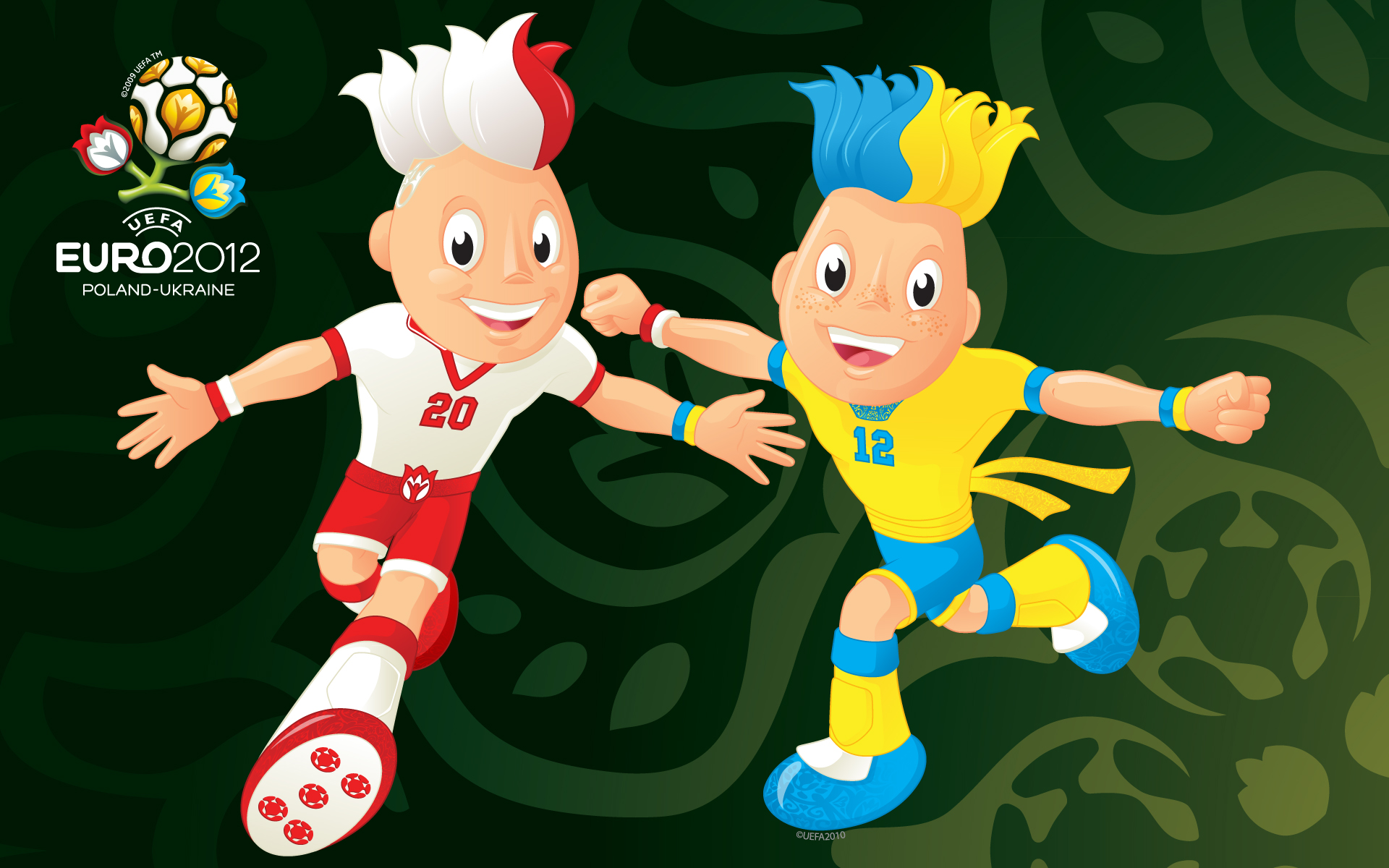
Stepping away from finance and football for a post or two.  With the Euro 2012 tournament rapidly approaching, I'm interested to see how the teams will fair in their final week of preparations.


Popular Teams:

England: Right now a buddy of mine really likes the Three Lions - can't say I feel the same.  I personally think they crash out in the first round.  A lot of tension in the squad, a new coach, and controversy can't make for a good ending.

Germany: My personal favorite.  A balanced squad, maybe lacking up front with Mario Gomez having failed to score a goal in an international tournament.  Strong midfield, quick defense, and great keeper should combine for a nice run in the tournament.

Netherlands: Has to be my favorite part II.  Really like the attacking side.  Guaranteed to be fluid.  Let's just hope if they make it to the final, like the last World Cup, they don't play so defensive.  The Oranje must stay true and play "Total Football" to hoist the trophy.

Spain:  Co-favorites with Germany at the books in Vegas.  Great squad.  Really balanced all around.  Could there be tension between the Barca and Real players?  If they play their game and keep morale high, look for Spain to continue to dominate in Europe.


Dark Horses:

Italy: Could they really be considered a dark horse?  Probably not, but with the gambling scandal filling the tabloids, the Azzurri could be the forgotten squad.  Full of capable players both young and old, the manager has got this versatile team primed for a deep run in Ukraine/Poland.

Croatia: Loving the Croats in this tournament.  They posses a great young coach, a talented playmaker, and a plethora of attacking options.  Croatia could surprise some folks this year with their discipled play and nose for goal.  Obviously, their group will be difficult to overcome, but if they do - watch out.

Sweden: I look for the yellow shirted Swedes to make a nice run in this tournament.  I truly think they go in ahead of England.  If Ibra heats up and the middies get going, look for goals galore.  This could be an interesting team to keep an eye on for the next few weeks.


That does it for a few team outlooks.  I may make a few more down the line.  Who knows?  Until then, get to a pub for the June 8th kickoff.  It will be a fun-filled and exciting tournament, guaranteed!


Monday, May 7, 2012

The Iberian Issue

Rising economic questions in Portugal and Spain have seemingly touched the football community.  I recently read a few articles in Businessweek, which got me thinking... What effects, if any, does this "sovereign debt crisis" have on the soccer across the Atlantic?  

http://www.businessweek.com/articles/2012-04-26/spanish-soccers-economic-crisis
http://www.businessweek.com/articles/2012-03-29/austerity-hits-soccer-fans-and-clubs

Surely less money will flow into the pockets of these Iberian clubs.  Simply put, they just do not have the resources, the capital, and the economic conditions to flourish.  But, that hasn't stopped a majority of European teams before.  We only have to look at Manchester United to see a team operating with absurd amounts of debt, yet doing just fine in the sports world.  A team like United, along with a plethora of other squads, acts like a charity according to Soccernomics.  No matter how bad the financials look, they will always have undying support and a revenue stream. 

Portugal and Spain will be fine.  Yes there will be a few clubs that fold, but that's to be expected.  Teams like Real Madrid and Barcelona in Spain and Benefica and Porto in Portugal will continue to remain relevant.  The money will come one way or another.  It is just a matter of time before the TV contracts are sorted.  At that point we will switch our attention to the Italian Serie A. 


Friday, April 27, 2012

Arsene Wegner: The Prudent Spender

Arsene Wenger is one of the most respected Economists in the footballing community today.  From shout-outs in the book Soccernomics (highly recommended read) to fanfare and media, Arsene has always brought a different financial approach to the modern game, one that will come to define a new age of modern football.


Mr. Wenger or the "Professor" as he is aptly known, started his career as a young boy in France.  While playing the beautiful game, he managed to complete a degree in Economics from the University of Strasbourg.  Arsene had a brief playing career followed by an interesting bout in various managerial roles.  Eventually the Professor landed in North London at Arsenal Football Club.  Since 1996 the club and coach have been synonymous with out of the box financial thinking.

Arsene Wenger has guided the Gunners through thick and thin, with his biggest test coming at the beginning of the current season.  Many question the seemingly financial prudence for a "top 4 club" in this time of economic splurging in European football.  Mr. Wenger has proved that, unlike many of the world's biggest clubs, one can run a team as a viable and profitable business.  This is perhaps his greatest feat.  Unable or perhaps, unwilling, to spend ludicrously on the world's most talented and expensive players; the Arsenal chief as implemented a system of bargain buys and record sales in the transfer market.  Looking at a small sample of these players, one can see the financial returns from player investments are astronomical (Anelka, Henry, Fabregas, Reyes, etc.).

Though this begs the question many of the Gunner faithful have been asking for 6 years now... Can such bargain hunting and money saving bring trophies to the Arsenal cupboards?  Well to that I say - Yes!

It has been a long few years since the last Arsenal triumph.  However, fans mustn't forget, Arsene did produce championship campaigns in both the Premier League and the FA Cup.  Times do change, one only as to look as across London to Chelsea or up north to Liverpool, and either Manchester United or City.  All of these teams have spent far more than Arsenal but have had a mixed bag of results.  United and Chelsea have certainly won plenty of titles, but City and Liverpool are yet to enjoy the feeling of lifting the Premier League trophy (Liverpool won the Champion's League and City the FA Cup in recent years).  The point being, Arsenal has had their fair share of success in the last decade.  Teams appear to be tilting back toward the direction of player development rather that opening up the checkbook - to supplement squad needs.

Arsene Wenger has a young, relatively cheap, nucleus of players.  This squad has performed spectacularly the last 10 or so games.  Players like Alex Song, Aaron Ramsey, Alex Oxlade-Chamberlain,  Kieran Gibbs, and Woj Szczesny all ring a bell.  Lest we forget the bargain buys of Robin Van Persie, a resurgent Tomas Rosicky, and Laurent Koscielny to name a few.  These players will undoubtedly improve going into next season.  Throw in a healthy Jack Wilshere and a few summer recruits, and the Professor has this squad looking really, really good for the future.


Like any type of investment, things take time.  Arsene Wenger and Arsenal are bound to skyrocket heading into the future.  The Gunners are shooting up the trough and bound to peak for the next few years.  The club is in extremely good financial health (the same cannot be said for the likes of United).  Arsene Wenger will prove once again, that prudent spending, player development, and a solid economic standing are a recipe for trophies.


Future and Footy

I cannot begin to explain how much I have not only benefitted, but learned from my experiences of blogging on the worldwide web. In writing about two topics which I am extremely passionate about, I was able to explore areas and gather information from intriguing realms. Academically speaking, my writing and research skills dramatically improved from the beginning to the end of the fall semester. I acquired an abundance of knowledge about the financial side of football, a topic that I previously overlooked. By striving to make each and every post more enlightening, engaging, and entertaining, I hopefully portrayed a sense of knowledge and ultimately, passion. In regards to my occupation, the ideal plan is to go abroad to one of the thousands of clubs in Europe. There, I plan to evaluate, analyze, and even create adequate transfer prices for professional players. This type of work requires a superb understanding of demographics of players and clubs, projections and forecasting, as well as awareness of current and potential economic conditions. By including an analysis paper I produced in one of my Urban Economics classes at the University of Southern California, I demonstrate a rather unique ability to examine a specific area and report my findings. This skill is relatively difficult to master, especially in a number and graph heavy subject such as Economics. Through my paper, I believe that I exhibit a certain capability. I show that I have a knack for taking something that I am already extremely knowledgeable about and can present it with facts, figures, and evidence to someone that is not necessarily as familiar. For a major club, I expect to write and evaluate similar pieces. By showing not only my financial, but also my football prowess in my blogfolio, I hope to garner a great deal of respect that will one day translate into a very pleasing and worthwhile career. The artifact can be found below.

Financial Power Rankings

The latest rankings from Deloitte are in... The richest club team in the soccer world is Real Madrid. Los Blancos as they are affectionately called, top the 2012 list ahead of arch rivals Barcelona who came in second. American owned Manchester United came in third with German giants Bayern Munich taking the 4th spot. The Premier League rounded out the top 5 with Arsenal FC.

Monday, February 13, 2012

Financial Fair Play: Wishful Thinking or Reality?


A recent report from a UEFA event in Geneva has the footballing world buzzing over potential systematic changes in European domestic leagues. The governing body that oversees European football recently announced plans to look into combating problems that are seemingly ruining the modern game. One of the most important issues the group of 100 plus delegates discussed was that of economic stability, specifically the growing questions surrounding the financial integrity of club football.

What is this system that UEFA is hoping to clean up? With the current rules in place, anyone with a large sum of money can seemingly buy a team. But why is this a problem and does not this happen all the time here in America? Yes, in the United States, takeovers happen sporadically. The difference in Europe is that once the team is in control of an owner, that individual can spend any amount of cash fiscally imaginable on every aspect of the club. There are no guidelines or system of checks and balances. These finances extend anywhere from a new stadium, board of directors, and most importantly and controversially, players. To put this into perspective, in America, players are traded and or signed off of free agency, whereas in Europe, players are bought for fees known as "transfers". The issue UEFA has with this is twofold. One, the richest owners can purchase the most expensive, best players, which only contributes to the increasing gap between rich and poor clubs. Secondly, domestic talent is not being developed, but instead, finished products are being bought from abroad. This is ruining some countries youth development systems and structures. Another key issue for the governing body is addressing the exorbitant wages most super stars have relative to, not only players on their own squad, but to players in similar leagues on less lucrative teams. UEFA intends to implement a policy in which clubs cannot repeatedly spend more than their income. Many clubs with ridiculously rich owners are actively ignoring aspects of business that would make most levelheaded people cringe, such as turnover and profit. I recently wrote an article condemning the spending of Manchester City. These new claims by UEFA are extremely exciting to the knowledgeable football fan for a reason. Ideally, European football will be played on a more level playing ground in a variety of aspects. This week, I decided to analyze and respond to a post by Bleacher Report author Stefan Vasilev. His intriguing write-up is titled, "UEFA's Newly Considered Regulations in Favor of Arsenal's Policy." I responded and commented on Mr. Vasilev's thought-provoking article which can be found by following the link below.
"UEFA's Newly Considered Regulations in Favor of Arsenal's Policy."
Comment

Mr. Vasilev,

I was more than pleased when I stumbled across your piece on UEFA's Financial Fair Play workshop. As an avid football fan and fellow Gunner, I find this topic to be one of the more riveting and pertinent debates in the modern game. You do extremely well to convey and outline the various points recently discussed in Geneva. You are right to question the "rich people who ignore the actual turnover of the club and take all financial issues in their own capable hands." I firmly believe that these men are ruining the game we have come to love and cherish. The likes of Roman Abramovich, Sheikh Mansour bin Zayed al Nahyan, and Florentino Perez (amongst many others) all possess good intentions and a solid interest in their specific teams, but do contribute to the growing inequality in contemporary football. These are extraordinarily savvy businessmen that have come to dominate their respective industries. In doing so, as you mentioned, they buy teams with little to no concern for the financial well being of their newly acquired clubs, nor the mindfulness for the wherewithal of the smaller teams in the league. What do you pose would happen if one of the aforementioned owners decided to abruptly sell the club? What kind of consequences might the team and players face? Do you pose there should be a salary cap similar to many American professional sports? UEFA is finally opening their eyes. In doing so, they are realizing the financial bedlams most of these clubs and leagues are experiencing. I only hope that it is not too late to correct this current mess.

Now that UEFA finally recognize the growing call for modification to the current system, the question of what can be done to improve the financial structure of European domestic leagues must be answered. In the article by UEFA, there is a claim that teams will need to "balance books" and will be given guidance on "salaries and transfer spending" as well as "sustainability of debt" and "to honour commitments on a timely basis." How might you suggest that UEFA oversee this and will they actually implement such a process in the near future? Most importantly I think this initiative by UEFA will address a few things that you failed to mention. By putting an emphasis on the future instead of the here and now, there is a hope to "stimulate long-term investment in youth development and upgrading facilities." Ideally, clubs will not only develop and maintain their domestic talent, but will create a strong financial basis for investment opportunities in new areas like stadia, sponsorship, branding, and marketing. But this begs the question, with income rising yet spending increasing at an even higher rate, how might these teams finally turn a profit in these struggling economic conditions? Surely UEFA cannot help each and every team, in every league, in a reasonable amount of time. I believe that this is an extremely big step from UEFA, but I question the financial rationality of such a wishful plan.

An Interesting Courtship

With the recent controversy surrounding the foreign purchase of Portsmouth Football Club, many fans are questioning the integrity and identity of English football. This is the latest team to be bought up and controlled by an individual who does not call England home which pushes the number of foreign owners in the twenty-team English Premier League to exactly half. This explains why this bid holds more significance than any of those in the past six years. With that, Portsmouth or Pompey, as their supporters affectionately call them, suffered a rather intriguing few months.

For starters, the team sits dead last in the Premiership (at the time of writing this entry). Moreover, Portsmouth possesses an amount of unmanaged debt unprecedented in the league, something that brings a huge question mark to their chance of survival. Simply put, there is chaos on the South Coast. The outfit recently revealed shocking news of their lack of ability to pay players, staff, and agents, amongst many others involved in the massive organization. This inability is something that the upper echelons of modern British football have never seen. Portsmouth has been in a catastrophic state, which has raised many eyebrows across the country. As if these problems were not enough, the club is welcoming its second owner in as many months. With its purchase at the hands of the wealthy Ali Al-Faraj, Pompey was thrown a life preserver, one that may keep them afloat in the Premier League. Though debt is not unheard of in the rest of Europe, why are so many of these English teams turning to investors from abroad instead of handling the problem at home? The Portsmouth situation brings about another sensitive question. What does the future hold in terms of ownership in the Premier League? While multiple fans and figureheads around England realize the positives and negatives associated with a foreign owner, it would appear from reactions that either something is being lost or everything is being gained.
Foreign ownership in the English Premier League has undoubtedly had numerous positive effects. One positive correlation appears to be titles and foreigners. Winning has become a habit for several of these cash-injected clubs. Championships and global popularity have increased immensely over recent years. Multiple teams are household names in many parts of the world and include the likes of Manchester United (American), Manchester City (United Arab Emirates), Liverpool (American), and Chelsea (Russian). The teams listed previously are some of the most successful clubs of this decade with Manchester United and Chelsea combining for seven of the last nine Premier League titles. Liverpool and Manchester United have collectively won two Champion's League titles this decade with English teams being involved in the last five finals (Chelsea being one and Liverpool losing out on one occasion). There is no doubt that, despite the ownership issues, England has dominated the competition for Europe's most sought after trophy. In these economic times, as demonstrated by the Portsmouth calamity, international investment has been instrumental in keeping many teams alive. Other clubs such as Chelsea FC have flourished under the watchful eye of their passionate owner, as noted by Giancarlo Abete, the President of the Italian Football Association, "The foreign owners have kept the clubs profitable and expanded their global outreach even if they have failed to win over the confidence of all their English fans." Chelsea, once a perennial underachiever, became a superpower because of Mr. Roman Abramovich and his dream. The charismatic, success-driven Russian billionaire purchased the club in 2003. Since then, he has bought hoards of players for top dollar. With that, very few Chelsea fans are questioning their influential owner and Premier League titles. By implementing a set of guidelines for owning a club known as the "Fit and Proper Persons Test" and the "5-step Ownership Test," the English Football Association is adapting to the times and encouraging owners of the highest moral fiber. Surely the profit and praise flowing in from around the world is enough to keep the mouths of rebellious fans closed. Former Birmingham City FC (potentially the next team to be purchased from abroad) Chairman, David Gold recently commented, "People cast new foreign investors into bogeymen, as if they are coming in to rape and pillage our wonderful game... I look at foreign owners coming in and I don't see any damage. I see the sophisticated leadership" Mr. Gold is right to a certain extent, unfortunately a large group of nationalistic fans do not appear to agree.

Many near and dear to their football squads feel foreign ownership takes a certain something away from the tradition of their beloved teams. Several clubs have been around for over a hundred years. Naturally, the fans have a unique, deep relationship, with their organization. Through foreign ownership, there is a sense of a loss of not only identity but also integrity, and at least some supporters perceive these changes as a sellout. Instead of operating from within, the clubs become headed by corporations and billionaires from without. Multiple Premier League teams were owned by either the fans or were passed down through generations of families, thus perpetuating an element of English nationalism and pride. These squads include the likes of Blackburn Rovers, Bolton Wanderers, Burnley, Everton, Hull City, Stoke City, Tottenham Hotspur, Wigan Athletic, and Wolverhampton Wanderers; with Arsenal possessing some form of minority English ownership. Managers are even speaking out against this trend in modern football. Arsenal FC boss Aresene Wegner, himself French, elaborates, "What was traditionally true in England is that the people who were the owners were the supporters... That was really reassuring for the fans because the heart of the owner was like their heart."

Another Frenchman, UEFA President Michel Platini recently took a jab at England, "I like people to put their money in their own leagues. You English can put in rules so you have no more foreign owners, like in Germany where no foreign owner can have more than 50 per cent of shares in a club." The most recognizable leagues around Europe possess little to no foreign owners. In France, a majority of the cities own their clubs. In Spain, the fans own most of the teams. Italy provides for an interesting example. Not only did Italy win the last World Cup with a squad that contained players that plied their trade exclusively in their home country, Italians owned all of these teams in the top flight. This is the model that several English supporters hope to emulate. Another issue is the problems facing the youth system. By encouraging foreign ownership and, consequently, foreign talent, many youngsters are being pushed out and underdeveloped. This has hurt the Three Lions (English National Team) in recent years with their last major trophy coming in 1966. The loss of the youth system and increase in foreign ownership has had its fair share of negative effects.
I acknowledge the financial benefits that many foreign owners have brought to the beautiful game in England. However, these businessmen are a manifestation of a problem that is much larger than ownership. English football is on the rocks in many ways. There appears to be an identity struggle that not only has fans from within, but also those abroad, asking difficult questions. Where has the soul of the game, which originated in the British Isles, gone? As mentioned before, numerous countries in continental Europe take pride in the fact that their owners are native sons or daughters hailing from the nation in which domestic league is located. In England there is a different mentality, which appears to suggest a loss of dignity at the hands of investment opportunities. Mr. Wegner concedes, "This tradition has gone. It looks as if we have gone from one period to a new one with more people who look at it as an investment where, of course, they want to be paid back quickly." Is this tradition lost forever? These next few years will surely tell us a lot of about the future of the English game, but my hope is that the Arsenal model, though itself under strain, represents the most promising path forward. That is to say, it is important to balance domestic and foreign ownership in conjunction with steady finances, for the well being of the club and its future. Now that half of the teams in England are owned from abroad, there is finally a sense on the home front that this is a pressing issue jeopardizing football. With Portsmouth struggling and many of the lower league teams begging for a cash influx, financial opportunities for foreign owners are constantly increasing. The tradition of English football is in peril. If something is not done swiftly, fans will surely lose their spirit, and with that, club leaders will lose integrity, and organizations will struggle with identity. Not all is lost, however clubs are coming to realize the importance of domestic owners, as seen at Arsenal and at teams across the country, which will hopefully recapture the pride and character that once defined English football.

Tuesday, May 24, 2011

#11 The Big Swede


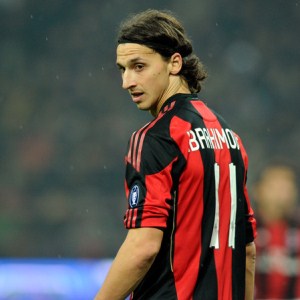
Zlatan Ibrahimovic is one of the most technically gifted strikers in the world. Blessed with amazing touch and remarkable physique, this Swedish international has dominated world football for quite some time. Though contracted to Barcelona, Zlatan plies his trade for AC Milan because of a loan deal. Ibrahimovic was instrumental in the Milan club's first place finish in the Serie A. With an unsure future ahead, it will be intriguing to see if the Swede ends up in England, Italy or back to Spain.

Monday, April 18, 2011

#10 The Dutch Playmaker


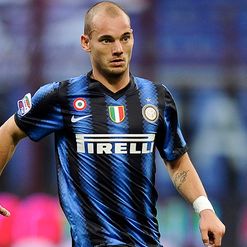
Originally I was going to put Lionel Messi down in this spot, however I realized that there are just far too many Barcelona players! That being said, I thought that Wesley Sneijder should have won FIFA Player of the Year last year for his memorable performances for both club and country. Sneijder hails from the Netherlands where he honed his skills at Ajax. Following a stop in Madrid, he eventually landed at Inter Milan where he won the Champion's League. In addition, he lead his team to the World Cup Final in 2010. Every time this player touches the ball, the opposing team cringes. Wesley can place an 80 yard pass on a dime. Sneijder is also renowned for his vision. These traits, coupled with the Dutchman's fine ability to shoot from distance, makes him one of the world's most dangerous midfielders. Wesley Sneijder is truly a pleasure to watch, one that will surely awe fans for years to come.

Wednesday, April 6, 2011

#9 The Defender's Nightmare


Samuel Eto'o has been a force in European football for the past seven years. His aggressive attitude, deft touch, and powerful shot have served the likes of Barcelona and Inter Milan well over his career. In addition to winning numerous league titles and Champion's League trophies, Eto'o is the captain of his native Cameroon. He has been named African Player of the Year on four occasions. Samuel is a constant force to be reckoned with, which leads opposing defenders to shake in their boots. Samuel Eto'o will surely be in the hunt to lead Serie A scorers come year's end and don't be surprised to find him on the score sheet for Inter Milan in their next Champion's League game.

Tuesday, March 22, 2011

#8 Stevie G


Steven Gerrard is one of the best English players to ever don the Liverpool shirt. He is so incredible that even the soccer god himself, Zinedine Zidane, considers Stevie G one of the best footballers in the world. Gerrard is an intriguing individual because he has played with the same club, Liverpool FC, since signing his youth contract. One characteristic of his game that is truly remarkable is his ability to shoot from distance. Along with his physical skill set, Gerrard has an uncanny ability to lead by example. Now at age 30, the Liverpool captain has won it all, except the English Premier League. Unfortunately for him, it does not appear that this is the year he gets his hands on a league medal. Despite Liverpool's recent struggles in the league, Stevie has thrived individually in Merseyside and with the Three Lions. Look for him to dazzle many and continue to succeed for the Reds in coming years!

Tuesday, February 22, 2011

#7 The Key to Success


With the addition of David Villa, the rich have gotten richer and the best have gotten better. Over the last two and a half seasons, Barcelona has been far and away the best team in the world. Now that Valencia's prized striker David Villa has joined them they are deeper and better than ever. His addition allowed Barca to ship malcontent Ibrahimovic to AC Milan. Ibrahimovic had fallen out of favor with the Catalan club thanks to his inconsistent effort. Effort has never been a problem for Villa. He lacks the size of a target man like Ibrahimovic, and doesn't have the speed of Messi, or even Fernando Torres. What he does have is the relentlessness needed to find space in front of opponents' back lines. He's always moving, searching out the best position on the field. It's therefore no surprise that he already has 20 goals in only 33 matches with Barca. He's also shown himself to be an excellent distributor of the ball as well, with 8 assists overall this season as well. Villa has fit in perfectly at Barcelona, and his addition is one of the primary reasons why Leo Messi is having a season for the ages. They play extremely well together, as neither is afraid to give the ball up. The best proof of their combined abilities are that holding them to one goal combined in the Champions League last week was seen by Arsenal as a great success. For the Gunners sake, I hope they're that successful again on March 8 at Camp Nou.

#6 The X Man


Xavi has been an integral part to Barcelona's success over the last handful of years. He is the maestro that pulls the strings and threads the passes that open opposing defenses. This Spaniard is widely regarded as one of the best players on the planet. Xavi may be little in stature but his uncanny vision and technique well make up for his lack of size. Though leading Barcelona to numerous medals, Xavi's greatest triumph is undoubtedly winning the World Cup. He is always a joy to watch and constantly receives praise from friends and foes alike. Look for Xavi and Barcelona to continue to dominate across Europe as the season continues.

Monday, February 14, 2011

#5 The Old Guard


Rio Ferdinand has been a staple of the English Premier League for over 10 years. Originally purchased for a record fee, Ferdinand honed his defensive skills at Leeds. Shortly thereafter, following financial turmoil, Leeds was forced to sell Rio to his current home, Manchester United. Since this record breaking transfer, United and Ferdinand have enjoyed an extremely successful relationship. This relationship has proved amazing for both parties. The Red Devils and the Englishman have won numerous titles, the most impressive being a Champion's League medal, as well as four Premier League titles. Rio Ferdinand has been a class act on the field for some time and will surely look to continue his winning ways with Manchester United well into the future.

#4 Captain Fantastic


Francesc Fabregas is one of the most popular players in the world. Hailing from Spain, the 23 year old is undoubtedly the heartbeat of Arsenal. Cesc as he is a affectionately called, is constantly in the spotlight. Whether leading his team to victory or never ending speculation over his imminent transfer to Barcelona, Fabregas continues to be at the forefront of attention in North London. He recently won the World Cup with the Spanish National team and is surely looking to win some silverware at the Emirates. With Arsenal playing Barcelona in the Champion's League this month, all eyes will be on the Gunner's captain in what will certainly be a tantalizing clash of flowing football.

Monday, January 3, 2011

#3 The Little Man With a Big Mouth


Patrice Evra continues to amaze spectators with his uncanny ability to make plays at both ends of the field. The French left back often finds himself in the papers for just about everything but his play. Evra is not afraid to let he world know exactly how he feels. Patrice famously led a mutiny in the latest World Cup as France went crashing out in complete embarrassment. For Manchester United, he has been a mainstay in the starting lineup for years. Patrice Evra's service to United and his excellent skill set make this man one of the world's best defenders.

Wednesday, December 22, 2010

#2 The Defender Who Loves to get Forward


Dani Alves has wowed fans for a number of years. Whether it be a tantalizing, rocket of a free kick or a stupid neck warmer, Alves continues to be quite the wing back (or whatever they call that position these days). The Brazilian has spent the better part of his career plying his trade in the Spanish Primera. Following a successful stint at in his homeland, Dani ventured across the Atlantic to Sevilla and eventually found a home at his current club, Barcelona. Dani Alves is a phenomenal player, one that is truly a joy to watch. Look for him to stop the opposing attack, while marauding forward as Barcelona try to capture the league title and progress through the Champion's League.

#1 The Best Current Goalkeeper


I have a soft spot for a guy that I grew up watching between the sticks. Iker Casillas is a very polarizing figure in the football world. Some feel that he is underserving of his lofty status, however many believe he is currently the best goalkeeper in the world. Playing for the reigning World Cup champions, Iker deservedly earned the right to don the title of the world's number 1 goalkeeper.That being said, at the time of this article, his Real Madrid squad are sitting second in the league, nipping at the heals of bitter rivals Barcelona. In addition to amazing us with his ability on the field, Casillas continues to impress us off the field by consistently being linked with some of the most attractive women in the world! Iker Casillas is currently the best on the globe and at the tender age of 29, he will surely continue to be an elite shot stopper well into the future.

Sunday, November 28, 2010

Players by the Number


In the coming weeks, I will highlight a player that I feel best represents a specific number for their European club team. In doing so, I hope to create a list that is both entertaining and insightful! This list will be in numerical order and will seemingly end somewhere after the number 1 and before 99. With that, enjoy and feel free to comment. Cheers.

Saturday, November 20, 2010

North London Derby

Today features the North London Derby. Should be a fun one. Arsenal will surely look to secure 3 points hosting Spurs. With the Gunners entering the fixture having won 5 of their last 6 games and Tottenham lacking to keep clean sheets against their bitter rival, look for a highly entertaining match. Though I am a huge Arsenal fan, I am excited to see two fascinating opposing players in Rafael Van der Vaart and Jermaine Jenas (no the latter is not a joke, just check out the first goal). Arsenal hope to get a number of players back in action for the game. It will be intriguing to see who exactly gets the start at a variety of positions. With a bevy of counter attacking options, Arsenal should expect to put a few in the back of the net. I know I'll be up and at 'em early in the morning to watch this enticing fixture.