With the recent controversy surrounding the foreign purchase of Portsmouth Football Club, many fans are questioning the integrity and identity of English football. This is the latest team to be bought up and controlled by an individual who does not call England home which pushes the number of foreign owners in the twenty-team English Premier League to exactly half. This explains why this bid holds more significance than any of those in the past six years. With that, Portsmouth or Pompey, as their supporters affectionately call them, suffered a rather intriguing few months.
For starters, the team sits dead last in the Premiership (at the time of writing this entry). Moreover, Portsmouth possesses an amount of unmanaged debt unprecedented in the league, something that brings a huge question mark to their chance of survival. Simply put, there is chaos on the South Coast. The outfit recently revealed shocking news of their lack of ability to pay players, staff, and agents, amongst many others involved in the massive organization. This inability is something that the upper echelons of modern British football have never seen. Portsmouth has been in a catastrophic state, which has raised many eyebrows across the country. As if these problems were not enough, the club is welcoming its second owner in as many months. With its purchase at the hands of the wealthy Ali Al-Faraj, Pompey was thrown a life preserver, one that may keep them afloat in the Premier League. Though debt is not unheard of in the rest of Europe, why are so many of these English teams turning to investors from abroad instead of handling the problem at home? The Portsmouth situation brings about another sensitive question. What does the future hold in terms of ownership in the Premier League? While multiple fans and figureheads around England realize the positives and negatives associated with a foreign owner, it would appear from reactions that either something is being lost or everything is being gained.
Foreign ownership in the English Premier League has undoubtedly had numerous positive effects. One positive correlation appears to be titles and foreigners. Winning has become a habit for several of these cash-injected clubs. Championships and global popularity have increased immensely over recent years. Multiple teams are household names in many parts of the world and include the likes of Manchester United (American), Manchester City (United Arab Emirates), Liverpool (American), and Chelsea (Russian). The teams listed previously are some of the most successful clubs of this decade with Manchester United and Chelsea combining for seven of the last nine Premier League titles. Liverpool and Manchester United have collectively won two Champion's League titles this decade with English teams being involved in the last five finals (Chelsea being one and Liverpool losing out on one occasion). There is no doubt that, despite the ownership issues, England has dominated the competition for Europe's most sought after trophy. In these economic times, as demonstrated by the Portsmouth calamity, international investment has been instrumental in keeping many teams alive. Other clubs such as Chelsea FC have flourished under the watchful eye of their passionate owner, as noted by Giancarlo Abete, the President of the Italian Football Association, "The foreign owners have kept the clubs profitable and expanded their global outreach even if they have failed to win over the confidence of all their English fans." Chelsea, once a perennial underachiever, became a superpower because of Mr. Roman Abramovich and his dream. The charismatic, success-driven Russian billionaire purchased the club in 2003. Since then, he has bought hoards of players for top dollar. With that, very few Chelsea fans are questioning their influential owner and Premier League titles. By implementing a set of guidelines for owning a club known as the "Fit and Proper Persons Test" and the "5-step Ownership Test," the English Football Association is adapting to the times and encouraging owners of the highest moral fiber. Surely the profit and praise flowing in from around the world is enough to keep the mouths of rebellious fans closed. Former Birmingham City FC (potentially the next team to be purchased from abroad) Chairman, David Gold recently commented, "People cast new foreign investors into bogeymen, as if they are coming in to rape and pillage our wonderful game... I look at foreign owners coming in and I don't see any damage. I see the sophisticated leadership" Mr. Gold is right to a certain extent, unfortunately a large group of nationalistic fans do not appear to agree.
Many near and dear to their football squads feel foreign ownership takes a certain something away from the tradition of their beloved teams. Several clubs have been around for over a hundred years. Naturally, the fans have a unique, deep relationship, with their organization. Through foreign ownership, there is a sense of a loss of not only identity but also integrity, and at least some supporters perceive these changes as a sellout. Instead of operating from within, the clubs become headed by corporations and billionaires from without. Multiple Premier League teams were owned by either the fans or were passed down through generations of families, thus perpetuating an element of English nationalism and pride. These squads include the likes of Blackburn Rovers, Bolton Wanderers, Burnley, Everton, Hull City, Stoke City, Tottenham Hotspur, Wigan Athletic, and Wolverhampton Wanderers; with Arsenal possessing some form of minority English ownership. Managers are even speaking out against this trend in modern football. Arsenal FC boss Aresene Wegner, himself French, elaborates, "What was traditionally true in England is that the people who were the owners were the supporters... That was really reassuring for the fans because the heart of the owner was like their heart."
Another Frenchman, UEFA President Michel Platini recently took a jab at England, "I like people to put their money in their own leagues. You English can put in rules so you have no more foreign owners, like in Germany where no foreign owner can have more than 50 per cent of shares in a club." The most recognizable leagues around Europe possess little to no foreign owners. In France, a majority of the cities own their clubs. In Spain, the fans own most of the teams. Italy provides for an interesting example. Not only did Italy win the last World Cup with a squad that contained players that plied their trade exclusively in their home country, Italians owned all of these teams in the top flight. This is the model that several English supporters hope to emulate. Another issue is the problems facing the youth system. By encouraging foreign ownership and, consequently, foreign talent, many youngsters are being pushed out and underdeveloped. This has hurt the Three Lions (English National Team) in recent years with their last major trophy coming in 1966. The loss of the youth system and increase in foreign ownership has had its fair share of negative effects.
I acknowledge the financial benefits that many foreign owners have brought to the beautiful game in England. However, these businessmen are a manifestation of a problem that is much larger than ownership. English football is on the rocks in many ways. There appears to be an identity struggle that not only has fans from within, but also those abroad, asking difficult questions. Where has the soul of the game, which originated in the British Isles, gone? As mentioned before, numerous countries in continental Europe take pride in the fact that their owners are native sons or daughters hailing from the nation in which domestic league is located. In England there is a different mentality, which appears to suggest a loss of dignity at the hands of investment opportunities. Mr. Wegner concedes, "This tradition has gone. It looks as if we have gone from one period to a new one with more people who look at it as an investment where, of course, they want to be paid back quickly." Is this tradition lost forever? These next few years will surely tell us a lot of about the future of the English game, but my hope is that the Arsenal model, though itself under strain, represents the most promising path forward. That is to say, it is important to balance domestic and foreign ownership in conjunction with steady finances, for the well being of the club and its future. Now that half of the teams in England are owned from abroad, there is finally a sense on the home front that this is a pressing issue jeopardizing football. With Portsmouth struggling and many of the lower league teams begging for a cash influx, financial opportunities for foreign owners are constantly increasing. The tradition of English football is in peril. If something is not done swiftly, fans will surely lose their spirit, and with that, club leaders will lose integrity, and organizations will struggle with identity. Not all is lost, however clubs are coming to realize the importance of domestic owners, as seen at Arsenal and at teams across the country, which will hopefully recapture the pride and character that once defined English football.
Monday, February 13, 2012

Tuesday, May 24, 2011
#11 The Big Swede
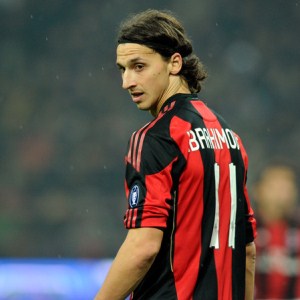
Zlatan Ibrahimovic is one of the most technically gifted strikers in the world. Blessed with amazing touch and remarkable physique, this Swedish international has dominated world football for quite some time. Though contracted to Barcelona, Zlatan plies his trade for AC Milan because of a loan deal. Ibrahimovic was instrumental in the Milan club's first place finish in the Serie A. With an unsure future ahead, it will be intriguing to see if the Swede ends up in England, Italy or back to Spain.
Monday, April 18, 2011
#10 The Dutch Playmaker
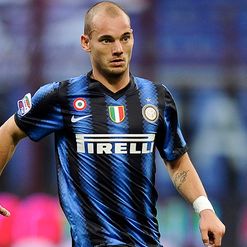
Originally I was going to put Lionel Messi down in this spot, however I realized that there are just far too many Barcelona players! That being said, I thought that Wesley Sneijder should have won FIFA Player of the Year last year for his memorable performances for both club and country. Sneijder hails from the Netherlands where he honed his skills at Ajax. Following a stop in Madrid, he eventually landed at Inter Milan where he won the Champion's League. In addition, he lead his team to the World Cup Final in 2010. Every time this player touches the ball, the opposing team cringes. Wesley can place an 80 yard pass on a dime. Sneijder is also renowned for his vision. These traits, coupled with the Dutchman's fine ability to shoot from distance, makes him one of the world's most dangerous midfielders. Wesley Sneijder is truly a pleasure to watch, one that will surely awe fans for years to come.
Wednesday, April 6, 2011
#9 The Defender's Nightmare

Samuel Eto'o has been a force in European football for the past seven years. His aggressive attitude, deft touch, and powerful shot have served the likes of Barcelona and Inter Milan well over his career. In addition to winning numerous league titles and Champion's League trophies, Eto'o is the captain of his native Cameroon. He has been named African Player of the Year on four occasions. Samuel is a constant force to be reckoned with, which leads opposing defenders to shake in their boots. Samuel Eto'o will surely be in the hunt to lead Serie A scorers come year's end and don't be surprised to find him on the score sheet for Inter Milan in their next Champion's League game.
Tuesday, March 22, 2011
#8 Stevie G

Steven Gerrard is one of the best English players to ever don the Liverpool shirt. He is so incredible that even the soccer god himself, Zinedine Zidane, considers Stevie G one of the best footballers in the world. Gerrard is an intriguing individual because he has played with the same club, Liverpool FC, since signing his youth contract. One characteristic of his game that is truly remarkable is his ability to shoot from distance. Along with his physical skill set, Gerrard has an uncanny ability to lead by example. Now at age 30, the Liverpool captain has won it all, except the English Premier League. Unfortunately for him, it does not appear that this is the year he gets his hands on a league medal. Despite Liverpool's recent struggles in the league, Stevie has thrived individually in Merseyside and with the Three Lions. Look for him to dazzle many and continue to succeed for the Reds in coming years!
Tuesday, February 22, 2011
#7 The Key to Success

With the addition of David Villa, the rich have gotten richer and the best have gotten better. Over the last two and a half seasons, Barcelona has been far and away the best team in the world. Now that Valencia's prized striker David Villa has joined them they are deeper and better than ever. His addition allowed Barca to ship malcontent Ibrahimovic to AC Milan. Ibrahimovic had fallen out of favor with the Catalan club thanks to his inconsistent effort. Effort has never been a problem for Villa. He lacks the size of a target man like Ibrahimovic, and doesn't have the speed of Messi, or even Fernando Torres. What he does have is the relentlessness needed to find space in front of opponents' back lines. He's always moving, searching out the best position on the field. It's therefore no surprise that he already has 20 goals in only 33 matches with Barca. He's also shown himself to be an excellent distributor of the ball as well, with 8 assists overall this season as well. Villa has fit in perfectly at Barcelona, and his addition is one of the primary reasons why Leo Messi is having a season for the ages. They play extremely well together, as neither is afraid to give the ball up. The best proof of their combined abilities are that holding them to one goal combined in the Champions League last week was seen by Arsenal as a great success. For the Gunners sake, I hope they're that successful again on March 8 at Camp Nou.
#6 The X Man

Xavi has been an integral part to Barcelona's success over the last handful of years. He is the maestro that pulls the strings and threads the passes that open opposing defenses. This Spaniard is widely regarded as one of the best players on the planet. Xavi may be little in stature but his uncanny vision and technique well make up for his lack of size. Though leading Barcelona to numerous medals, Xavi's greatest triumph is undoubtedly winning the World Cup. He is always a joy to watch and constantly receives praise from friends and foes alike. Look for Xavi and Barcelona to continue to dominate across Europe as the season continues.
Subscribe to:
Posts (Atom)